
Equipment protecting critical infrastructure cannot be shut down. In particular, fire suppression systems must always maintain adequate pressure to operate immediately when necessary, and to achieve this, critical components such as closed impellers must operate reliably and continuously.
However, the existing impeller used by the customer was becoming a bottleneck in terms of production and maintenance.
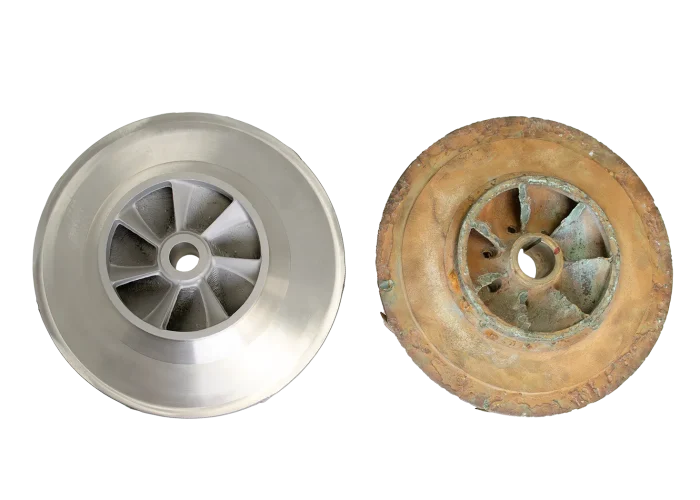
The existing parts were made of cast bronze, resulting in long lead times and susceptibility to wear in continuous operating environments. To address these issues, the customer utilized Meltio's metal additive manufacturing technology to redesign the part's material and manufacturing process.
Parts that must withstand continuous pressure and repetitive loads
When the fire suppression system operates, the impeller must reach its maximum rotational speed within seconds from a standstill. During this rapid startup process, high torque is transmitted throughout the system, generating significant mechanical loads on the impeller and connecting parts.
Even after normal operation begins, the impeller is continuously exposed to the following environments.
- Repetitive loading due to vibration
- Erosion caused by fluid flow
- Surface damage caused by corrosive fluids
- Wear and tear due to long-term driving
Therefore, the performance degradation of the impeller is not a matter of whether it occurs, but at what point it occurs.
From casting to custom additive manufacturing
The existing impeller was made of cast bronze.
While bronze provides sufficient strength, the need for mold making and casting processes results in long lead times, limiting the rapid parts supply and on-site response required in modern industrial environments.
The customer changed the impeller material to 316LSi stainless steel by applying Meltio's Directed Energy Deposition (DED) technology.
Through this, we were able to secure superior mechanical properties, corrosion resistance, and fatigue resistance compared to existing parts.
In addition, the geometry was optimized for additive manufacturing, and Meltio's Radial 360 toolpath strategy, dedicated supports, and variable additive conditions were applied.
As a result, we established a process that enables the rapid production of parts when needed, without the need for separate casting molds.

Precision additive manufacturing completed in two steps
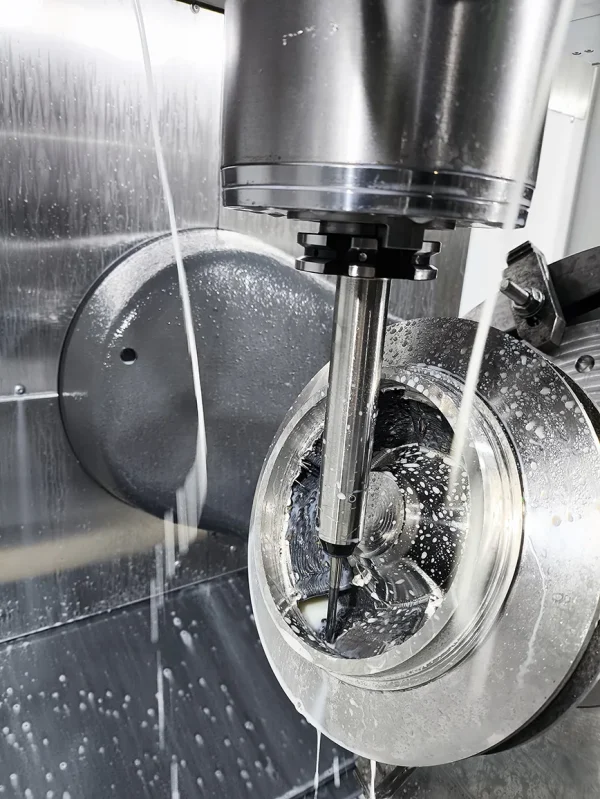
The first output demonstrated sufficient functional performance. However, several areas for improvement were identified during the process of precisely machining the complex internal shape made of high-strength stainless steel.
In particular, the lower area where the support was applied did not have sufficiently smooth surface quality, and in some parts of the curved section, the layer thickness was somewhat excessive, requiring additional post-processing.
To address this, a method of separating the manufacturing process into two stages was applied.
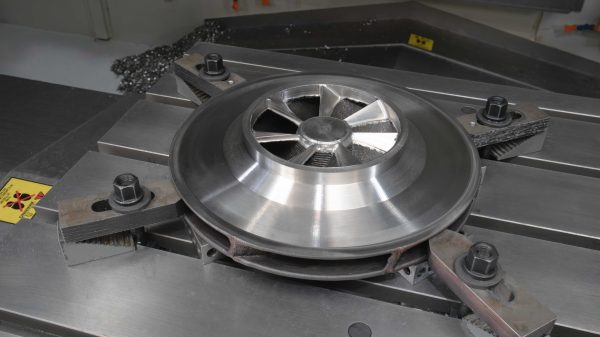
This is a method in which a portion of the impeller's shape is first laminated, intermediate processing is performed, and then the remaining shape is laminated again.
By utilizing the Meltio positioning system during this process, the position and coordinate system between the two additive manufacturing steps can be accurately maintained. This increases machining accessibility to the internal blade and further enhances final dimensional accuracy and surface quality.

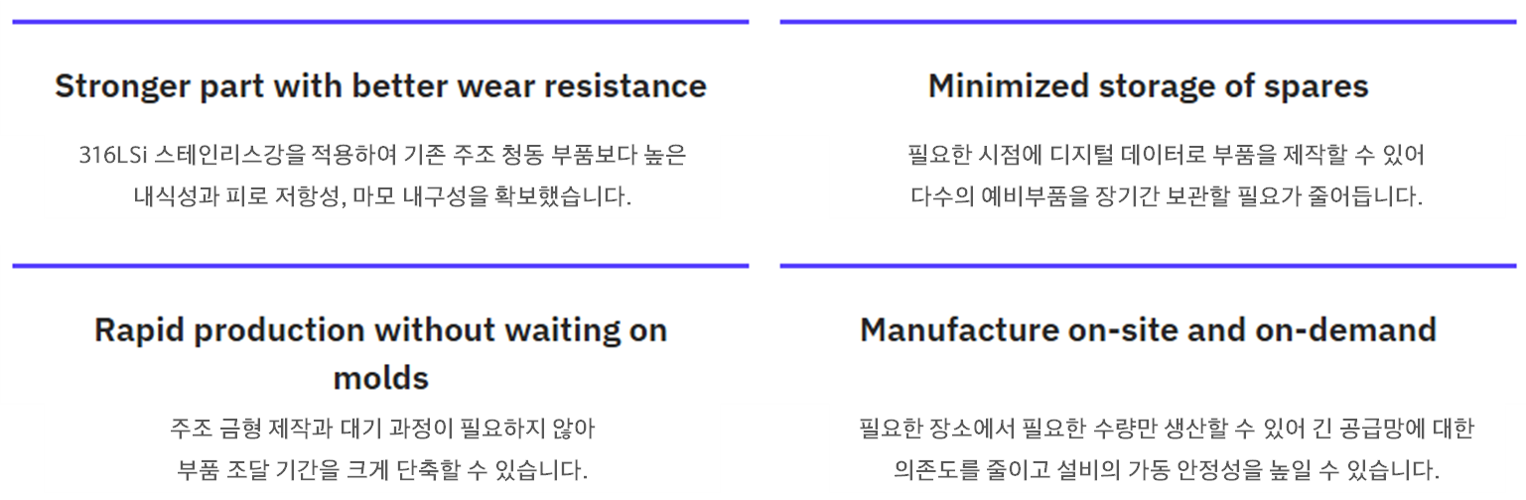
Benefits secured through the transition to additive manufacturing
By transitioning from the traditional casting method to metal additive manufacturing, the customer was able to go beyond simply manufacturing new impellers and establish a more flexible and efficient maintenance system.