


Reasons for choosing Meltio technology
ACNS, a company specializing in automation and robot system integration, selected Meltio's industrial wire laser metal deposition technology after comparing various metal additive manufacturing technologies with existing manufacturing methods.
The main reasons ACNS chose Meltio technology are the efficiency of material utilization, precise process control, and flexible system integration.
- Use wire instead of powder
Meltio uses wire as a material instead of metal powder.
Metal wire has the advantage of being relatively inexpensive, allowing for easy acquisition of certified-grade materials, and enabling the supplied wire to be utilized for deposition.
In addition, since there is no need to handle hazardous metal powder, it can be used in general manufacturing workplaces without the need for separate, isolated dedicated facilities.
- Use laser instead of arc
Meltio's laser-based deposition method can form finer beads and reduce heat input compared to Wire Arc Additive Manufacturing (WAAM).
This enables more precise dimensional control and reduces the machining allowance required for subsequent cutting.
- Open System Integration
Meltio provides the core engine for metal deposition, and ACNS builds manufacturing cells tailored to customer requirements based on this.
Since the Meltio head can be integrated into standard industrial robots such as FANUC, the manufacturable area can be expanded depending on the robot's working range.
also Implementing a hybrid manufacturing process that combines metal deposition and machining in a single manufacturing cellYou can do it.
- Utilization of ACNS's Meltio robot cell
ACNS is a company specializing in automation and robot system integration rather than a manufacturer that produces parts directly, and utilizes Meltio robot cells for the following purposes.
– Manufacturing technology and process development
– Process Qualification
– Technology demonstration for potential customers
– Production of parts for manufacturability review for customers and universities/research institutions
The reason ACNS adopted additive manufacturing technology lies in customer requirements that are difficult to address with conventional manufacturing methods.
Typical examples include large parts requiring small-batch production, replacement of wear parts with long lead times, fabrication of single-part tooling, and complex internal geometries that are difficult to access with conventional machining.
ACNS utilizes additive manufacturing technology not as a replacement for existing subtractive or welding processes, but as a manufacturing technology that complements them.
Cooling channel design that overcomes the limitations of conventional drilling
The challenges ACNS focused on in this technology demonstration project are important in various industries Thermal Management Technologyno see.
Cooling performance is an important factor in the design of molds, industrial equipment, and high-performance machine parts.
The technology implemented in this project can be applied to the following fields.
– Conformal Cooling of Molds and Tooling
– Cooling housings and manifolds for energy and process equipment
– Internal cooling structure of high-performance machine parts
- Limitations of existing cooling channel manufacturing methods
Conventional cooling channels are typically manufactured by drilling.
Therefore, the location and shape of the cooling channels are limited by the direction and depth that the drill can access.
Due to these constraints, it is difficult to implement the cooling path exactly as desired by the designer, and there are cases where the design must be modified to fit the machinable shape.
In addition, conventional methods often construct cooling structures by combining drilled cooling channels, plugs to block them, and sealing covers.
This multi-part assembly method requires separate sealing and assembly processes.
- Implementation of an integrated cooling channel using Meltio technology
By utilizing Meltio's wire laser metal deposition technology, internal cooling channels can be formed during the part fabrication process.
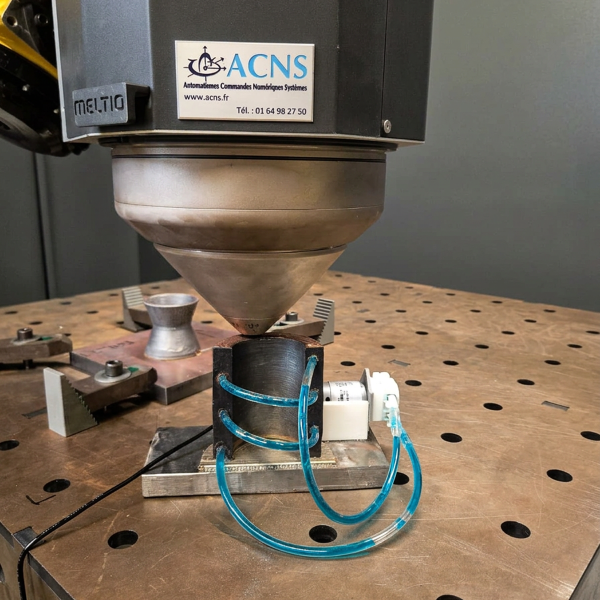
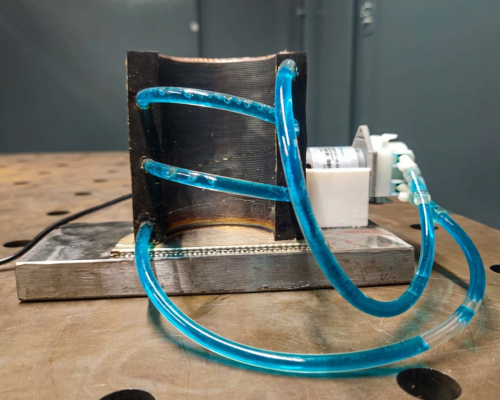
This is a method in which, instead of separately drilling cooling channels, cooling channels are designed along the shape of the surface requiring cooling and implemented during the deposition process.
This allows the cooling structure, which is composed of multiple existing parts, to be manufactured as a single monolithic part.
- Key advantages of the integrated structure
– Reduction of potential leakage points
By reducing the structure connecting various parts, the paths through which cooling fluid can leak can be minimized.
– Reduction in the number of parts
You can integrate parts that previously had to be manufactured and assembled individually into a single structure.
– Elimination of sealing and assembly processes
It can be designed so that separate sealing and assembly work, such as for plugs and sealing covers, is not required.
– Improved design freedom of cooling channels
You can design cooling channels tailored to areas requiring cooling, without being constrained by the approach direction of conventional drilling.
Through Meltio technology, cooling channels are not structures that must be designed to fit the constraints of conventional machining methods, but rather elements that can be freely designed according to cooling performance.
Manufacturing cost reduction and industrial application effects
This project is an example of manufacturing a technology demonstration part (Demonstrator) rather than a mass-produced part for an actual customer.
Therefore, specific cost reduction figures were not presented due to the lack of a comparison standard regarding the manufacturing cost or mass production quantity of existing customer parts.
However, by applying an integrated structure, the cost-saving factors that can occur in the manufacturing process can be clearly identified.
① Elimination of assembly and sealing processes
Assembly and sealing operations required in existing multi-part structures can be eliminated.
This allows you to reduce additional processes that need to be performed after parts are manufactured.
② Reduction in the number of parts
By manufacturing a cooling structure composed of multiple parts into a single integrated component, the total number of parts can be significantly reduced.
③ Reduction in material usage
In conventional cutting processes, a significant amount of material may need to be removed to achieve the final shape.
On the other hand, Meltio's metal deposition method can reduce the amount of unnecessary material removal because it deposits material at the required locations.
- Possibility of implementation in general manufacturing sites
Since the Meltio head can be integrated into standard industrial robots, the technology can be introduced even in existing manufacturing workplaces.
Another advantage is that it can reduce reliance on facilities dedicated to special metal powders or highly specialized additive manufacturing personnel.
In addition, by utilizing the same manufacturing cell, it is possible not only to produce new parts but also to perform repair and regeneration work on existing worn parts.
The difference between mass production and small-batch, high-value-added component manufacturing
ACNS explains that Meltio technology does not replace existing processes in all manufacturing environments.
Traditional manufacturing methods such as casting, forging, and machining remain competitive, especially when mass-producing industrial metal parts.
On the other hand, Meltio technology offers high utility value under the following manufacturing conditions.
- Single item and small-batch production
It is suitable for producing the required quantity of parts without separate molds or complex manufacturing preparation processes for mass production.
- Manufacturing of large metal parts
You can manufacture medium to large metal parts by utilizing the working range of industrial robots.
- High-value-added parts repair
It can be used for repair and restoration work by additionally depositing metal material onto worn or damaged areas of existing parts.
- Manufacturing of complex internal shapes
It is suitable for implementing internal structures that are difficult to produce with conventional cutting processes.
A representative example is the **Monolithic Cooling Cylinder with Internal Cooling Channels** produced in this project.
ACNS evaluates that Meltio technology is particularly suitable for the repair of single parts, small-batch production, large parts, and high-value parts, as well as for the manufacturing of complex internal geometries.
